General Issues

Switched-on reading – decoding media in the Misinformation Age

icon-myth-new@2000x

How myths start and spread

Do you believe everything you read? Or hear? Of course not.

But in an era where anyone can post online, separating fact from fiction isn’t always easy. The loudest voices often aren’t the most accurate—and fear sells faster than facts.

Many chemical myths begin with a single media story. All it takes is one story with an angle that generates fear or outrage—mentioning babies, pregnancy or cancer usually does the trick—and the message can ‘go viral’ around online news sources, blogs and social media. All parroting the same message and amplifying the fear.

Reporting on chemical risks is tough. The science is complex, involving toxicology, medicine and regulatory science. But media stories need to be short and engaging, which can lead to oversimplification. And because dramatic headlines get clicks, stories are often exaggerated or one-sided. Add our natural negativity bias, and scary headlines start to dominate—even if they don’t reflect the science.

So how can we become better at spotting incorrect information?

Science spot icon
Negative information sticks!

One study found that we have ‘a pronounced susceptibility to negative information even from distrusted sources’1

Facts icon

What are the facts?

  • Australians are sceptical—but myths still stick

    Many Australians are sceptical about what they’re told. For example, in 2025 just 37% of Australians said they trusted the media — making it the most distrusted institution in the country.2

    Still, myths stick. Influencers, viral headlines and social posts spread them faster than facts can keep up.  

    For example, even the most logical and rational human on the planet may have that persistent niggle in the back of their head that mobile phones might cause cancer (nope). Others who are swayed more by headlines may live in fear that everything causes cancer.
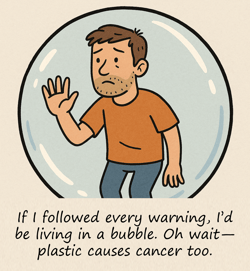
    Everything causes cancerSome of the more bizarre alleged ‘causes’ of cancer

    Wearing a bra
    Air travel
    Mobile phones
    Oxygen…
    ...and there are many more. 


furphies-icon-deep-teal@2000x

The bottom line?

Misinformation spreads fast, but critical thinking spreads truth.
Be the one who questions the headline, checks the facts and helps stop the spread of chemical myths. 
Read more on the impacts of 'chemophobia'
Sources
  1. Baum J & Rahman RA, 2021 ‘Negative news dominates fast and slow brain responses and social judgments even after source credibility evaluation’, NeuroImage, Vol 244.
  2. 2025 Edelman Trust Barometer, Global Report: Trust and the Crisis of Grievance
  3. Edelman Trust Barometer 2023, Special Report: Trust and Health. Note: Australia was not included