Extra! Extra! Toxic chemicals found in... (Dose matters!)
What's the myth?
It is quite common to see headlines screaming ‘Toxic Chemicals Found in [insert everyday product]’. Or along similar lines.
Have you ever been thrown by a headline like this?
Unfortunately, such headlines can cause unnecessary alarm by perpetuating a common misconception: that the presence of a chemical means that it will cause harm.
Not necessarily—amounts matter! Amounts, aka ‘dose’.
What are the facts?
-
‘All substances are poisonous: there are none that are not. The dose alone differentiates a poison from remedy’
This concept is attributed to Paracelsus (1493-1541), a Swiss physician, botanist and alchemist, known as the ‘father of toxicology’.
Any substance can be harmful in certain quantities, or in the wrong place, or if used in the wrong way.
Or, to put it in toxicology terms, the risk of harm depends on the hazard – the substance’s inherent ability to cause harm, and the dose – what quantity of the substance, in what concentration, and for what duration of contact.
All chemicals have the potential to cause harm at high enough doses, but there is also a level below which a chemical has no adverse effect. Of course, this applies to natural chemicals as well as man-made chemicals—their origin is irrelevant. And there is no such thing as ‘chemical free’.
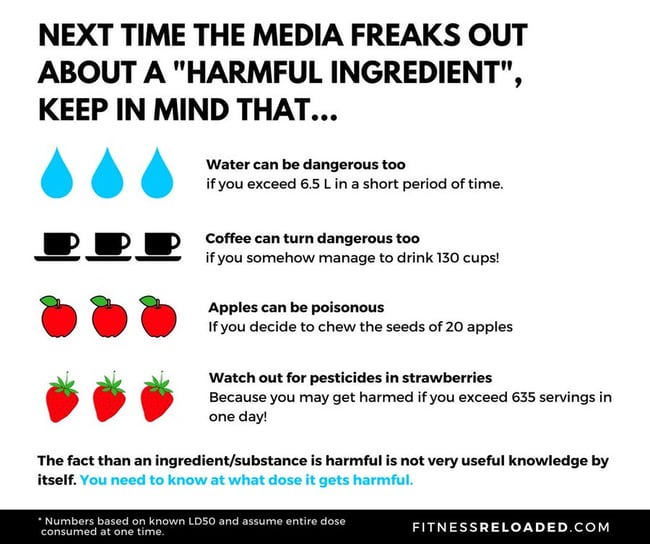
Think about some common, natural foods. Apples, pears, potatoes and zucchini all contain substances that are toxic to people. But do we need to worry? No, the amounts are so small that they have no harmful effects.
Or, perhaps more relevant to some, coffee. Every time you drink a cup of coffee, you may be consuming as many as 16 ingredients that are carcinogenic to rodents. If you don’t drink coffee, how about a buttered bread roll with roast turkey and cherry tomatoes? 11 known carcinogens.1 Should we ban coffee, turkey, tomatoes and rolls? Of course not. There is no evidence that consumption of these trace levels is unsafe. Dose is an essential concept here.
Examples of right substance, wrong dose
Vitamin A is essential to the proper functioning of the human body. We get vitamin A from the foods that we eat. However, too much vitamin A can cause poisoning and death.

During their famous Antarctic journey, it is thought that Douglas Mawson and Dr Xavier Mertz ingested toxic levels of vitamin A as they resorted to eating the livers of their huskie dogs to survive. Dr Mertz died, but Mawson staggered 160 km to safety. Liver has since been found to be a very rich source of vitamin A.
Or think about aspirin. One or two tablets every few hours can give pain relief. Fifty tablets all at once could cause acute kidney failure, coma and heart failure. -
How a substance comes into contact with the body is also important
Another important consideration is the route by which a substance contacts or enters the body.
There are four major routes of exposure:- oral – ingested by mouth
- dermal – applied to the skin
- inhalation – breathed into the lungs
- intravenous – injected into the bloodstream
Substances that may cause harm via one route may have minimal effect via another. For example, the skin is a highly effective barrier to certain substances.
Therefore, different routes of exposure may result in different rates of absorption into the body, or mean that a substance cannot reach a part of the body where it would cause harm.
Examples of right substance, wrong route of exposure
The obvious example is water. We die without it. But water can also kill. If we get too much in our lungs it causes asphyxiation.
Or lead. Touching a block of lead is not usually harmful because lead is not absorbed well through the skin. But breathing or swallowing enough lead can result in lead poisoning. -
Just because a substance is found in the body does not mean it causes harm
Every day we are exposed to many chemical substances from both natural and man-made sources. This has been the case for thousands of years. For example, foods naturally contain carcinogens, allergens and other toxic substances. But because we consume low doses and a variety of foods, our bodies can deal with the quantities of these substances we ingest.

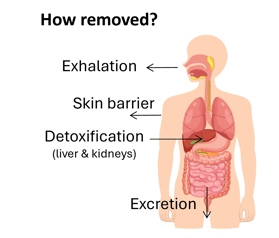
Plus, our bodies are equipped to eliminate many substances that have the potential to cause harm. The main way in which our body does this is by metabolising the substance (transforming it to other substances) in the liver or kidneys and excreting the metabolites from the body, primarily via urine or faeces.
Individual characteristics, such as age, gender, lifestyle and health status, can play a part in how our bodies deal with different substances.
Health authorities consider factors such as the hazard, dose, route of exposure and individual characteristics when considering the safety of products that we may come into contact with.
Considering all of these things together determines the risk – the likelihood of harm resulting from exposure to a potential hazard. Click here for more information on product safety.
So, just because a substance can be detected in the body doesn’t mean that it will have any negative impact.
-
Analytical techniques are always improving, meaning we can detect lower and lower levels
Analytical techniques in science and industry are constantly advancing, allowing us to detect substances at lower and lower concentrations.
Today, we can detect trace levels of chemicals down to parts per billion (ppb) or even parts per trillion (ppt), a capability that would have been unimaginable a few decades ago.
So, while this increase in sensitivity might mean you hear more and more claims of ‘[Scary chemical] found in…’, the key thing to remember is that amounts matter.
The mere presence of a substance does not mean it poses a risk. It’s the dose that determines the danger. The detection of a minute amount of a synthetic or natural chemical does not automatically equate to harm.
For example, modern techniques can find tiny residues of pesticides on fruits, but these residues are often well below the levels deemed safe by regulatory bodies.
The same applies to trace contaminants in drinking water or cosmetics—detection does not equal danger.So, while our tools are getting better at finding ever-smaller amounts of substances, the health and safety implications depend on how much of a substance is present, not simply whether it can be detected. It’s a case of greater awareness, but no need for greater alarm.