Nanomaterials – tiny trouble?
What are they?
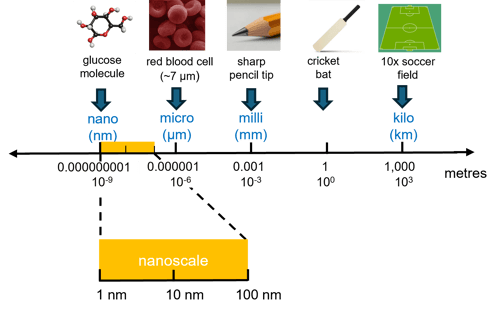
Nanomaterials are materials that are extremely small. Think molecule-scale. Like glucose molecules and the diameter of DNA. Like viruses.
As a comparison, a human hair (pretty narrow, right?) is approximately 80,000 nanometres thick.
Although there is currently no internationally agreed definition for ‘nanomaterial’, the range of 1-100 nanometres is generally referred to as ‘nanoscale’.
AICIS, the Australian industrial chemicals regulator, defines a nanomaterial as having at least one dimension 100 nanometres or less.1

Science spot
Nanomaterials can occur naturally, be produced by human activities, or be engineered by man.
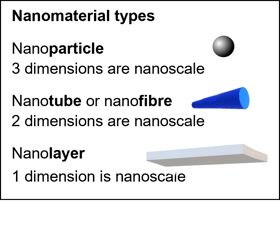
There are two main ways to engineer nanomaterials: to build them up chemically from the molecular level, or to mill them down mechanically from larger substances.
Nanomaterials can behave differently to larger particles of the same substance. For example, zinc sunscreen (non-nano) goes on your skin white, while nano-zinc sunscreen is transparent. Nano-aluminium has antibacterial properties, while aluminium foil (for example) does not.
What's the myth?
Nanomaterials can have novel properties based on their size.
This means potential opportunities for new technologies based on nanomaterials. One of the most appealing areas of nanotechnology research is in medical applications such as targeted drug delivery, diagnostics, implants and chemotherapy.
But novel properties can also raise the question of safety. It has been suggested that engineered nanoparticles are just too risky. For example, Friends of the Earth have a long-running (but fairly silent, at present) anti-nano campaign.
It’s a legitimate question that should be asked – are nanomaterials safe for humans and the environment?
But as we will see below, questioning the safety of nanomaterials as a whole category is not the way to go.
What are the facts?
-
We all encounter many different nanomaterials every day
We are all exposed to many different nanomaterials in daily life. We consume nanoparticles in food and drink.2 We inhale nanoparticles from natural sources, like forest fires, plants and algae, and from man-made sources, like nanoparticles created as products of combustion and cooking. Minerals can also exist on the nano-scale.
And we encounter some nanomaterials that are added to some everyday products.
-
Nanomaterials vary greatly in properties – they are not a uniform category
When considering the benefits and the risks of new nanomaterials, it is important to remember that all nanomaterials are not the same. Just as all ‘materials’ are not the same.
‘Nano’ simply indicates a scale of particle size. Particles on the nanoscale will vary greatly in terms of properties, applications and hazards. There is no set of properties that is common to all nanomaterials. Nor do all nanomaterials have a common set of risks.
Just like other chemicals, nanomaterials need to be considered as the individual substances that they are.
Not all nanomaterials are the same.
Just as all ‘materials’ are not all the same!However, nanoparticles of a material may have different properties to larger particles of the same material – so this needs to be considered when assessing risk
-
Australia’s regulatory system manages any risks of nanomaterials – like for other chemicals
Nanomaterials used in cosmetics, personal care and hygiene products are regulated by the Australian Industrial Chemicals Introduction Scheme (AICIS). Sun protection products with SPF15+ or higher are regulated by the Therapeutic Goods Administration (TGA). Both these agencies independently assess the safety of product ingredients.
For example, AICIS has specific processes in place for nanoscale chemicals to manage uncertainty about the risks of some. That could mean a risk assessment or increased reporting or record-keeping requirements for some nanoscale chemicals.
But apart from nano-scale titanium dioxide and zinc oxide in some sun protection products, nanomaterials are not widely used in the cosmetics, personal care and hygiene products available in Australia.
Click here for more information on nanoparticles in sunscreen products
The bottom line?
Not many ‘nano’ ingredients are used in cosmetics, personal care and hygiene products. But these ingredients are covered by Australia’s rigorous regulatory system, just like other ingredients.
No need to…
worry about nano! (Don’t look but you’re breathing in nano right now…3)
But please do...
trust that the rigorous regulatory system in Australia is aware of and looking out for risks to do with nanomaterials, as it is for other materials.
Sources
- AICIS, Categorisation of chemicals at the nanoscale
- McClements, DJ, Xiao, H. 'Is nano safe in foods? Establishing the factors impacting the gastrointestinal fate and toxicity of organic and inorganic food-grade nanoparticles'. npj Sci Food 1, 6 (2017)
- Andrew Maynard, Apr 5, 2008, ‘I’m breathing in nanoparticles, so why aren’t I dead already?’, 2020 Science