Some health-related terms – defined
Below are some common health-related terms that you’ll come across on Furphies and other information sources.
Understanding these terms will help you understand claims and information about the products you use every day.
-
Allergy
An allergic reaction is when your body’s immune system overreacts to substances in the environment—substances that are generally harmless to most people. These substances are called allergens.
There are many different allergens. Some well-known ones are dust mites, pollen, certain foods (e.g. peanuts, cow's milk, soy, seafood and eggs), animal fur, insect stings, moulds and medicines. Almost any substance, natural or man-made, has the potential to produce an allergic reaction in someone, somewhere.
Allergies affect roughly one in three Australians at some time in their lives. Symptoms range from mild swelling, watery eyes and sneezing, to life-threatening anaphylaxis. Allergy is also one of the major factors associated with asthma.
Allergic reactions to ingredients in cosmetic and personal care products are rare. The fact that products contain very low levels of the most common allergens, coupled with the fact that many cosmetic and personal care products are rinsed off the skin, helps minimise allergic reactions. Localised skin reactions are the most common allergic responses.
-
Asthma
Asthma is a chronic lung disease in which the airways are sensitive, narrowing when exposed to certain triggers. This makes breathing more difficult. Symptoms of asthma include recurrent wheezing, chest tightness, shortness of breath and coughing. Severe asthma attacks can lead to hospitalisation.
-
Cancer
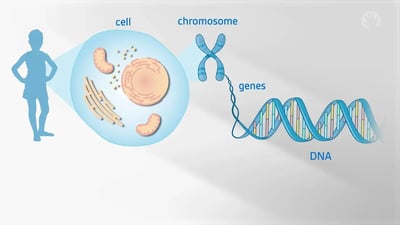
Cancer is the uncontrolled reproduction of cells in the body. This is caused by damage to a cell’s DNA.
DNA?
Deoxyribonucleic acid. The ‘blueprint of you’.
DNA is a large, complex molecule (yes, it’s a chemical) that tells your body how to develop, function and reproduce.Normally, when DNA damage occurs, the cell will either repair the DNA or the cell will die. However, cancer forms when the DNA is not repaired and, rather than dying like normal cells, these abnormal cells grow out of control.
Cancer can result in the formation of a localised tumour, or can involve the bloodstream or lymphatic system, from where cancer cells can reach and invade other body tissues.
Agents that can cause cancer are called carcinogens. These include chemical agents and radiation (e.g. UV light, radioactive substances).
Other risk factors for cancer include genetic susceptibility and hormonal factors, and lifestyle factors such as smoking, alcohol consumption, obesity, diet, UV exposure and some infections. The risk of developing cancer increases with age.
It is not always possible to determine the cause of a particular case of cancer. A ‘mutagen’ is another term for an agent that can cause DNA damage and may result in cancer in the exposed individual or effects in subsequent generations.
In Australia, the most common cancers (excluding non-melanoma skin cancer) are prostate cancer, breast cancer, melanoma of the skin, colorectal cancer and lung cancer.1

-
Endocrine disruption / Hormone disruption
The endocrine system is the system of glands responsible for releasing hormones into the bloodstream. Once in the blood, hormones act like chemical messengers, circulating in the blood until they reach their target organ.
Hormones regulate all of the body’s biological processes throughout life, including growth, development and metabolism. The pituitary, thyroid and adrenal glands, as well as the female ovaries and male testes, are major components of the endocrine system.
Endocrine disruptors are substances that may interfere with the action of natural hormones. They might mimic natural hormones, block the action of natural hormones, or directly stimulate or inhibit the production of hormones.
The effects of endocrine system disruption will vary widely depending on the part of the endocrine system that is affected. It could result in a range of human health effects, including on development, reproduction, immune and nervous system function, increased cancer risk, etc.
Some drugs deliberately act as endocrine disruptors, such as the birth control pill. Other endocrine disruptors are found in our environment.
-
Irritation
Irritation is a broad term meaning a temporary state of inflammation or painful reaction. Irritants include some chemical agents, mechanical stimuli, heat and radiation. They can act on the skin, eyes or respiratory system.
An allergic reaction can result in irritation, but an irritant is different to an allergen. An allergen causes a specific response from the immune system in a specific individual, whereas an irritant does not involve an immune response, and is less specific.
For cosmetic, personal care and cleaning products, irritation would normally relate to the skin. Skin irritation can refer to a range of problems, including rashes, lesions and itchiness, which can vary in severity and duration.
Cleaning products contain instructions for use that minimise the chance of skin contact and irritation.
-
Sensitisation
Some people can develop an allergic reaction to a substance over time. This is called sensitisation. It’s a particular type of allergy to a substance that develops only after there has been previous exposure to that substance.
A substance that causes an allergic reaction only after previous exposure to that substance is called a sensitiser. After the initial exposure, often only a low dose of the sensitiser may be required to trigger an allergic reaction.
-
Toxicity
Toxicity is the degree to which a substance can harm or damage a biological system (e.g., an organism, tissue or cell).
Toxic effects can be short-term (acute), like food poisoning, or long-term (chronic), like lung cancer. They can range from mild to severe.
Any substance has the potential to cause toxic effects. Whether it will or not depends on the dose and the way in which it comes in contact with the organism. For a toxic effect to occur, enough of the substance needs to reach part of the body where it can cause harm. Some substances are classified as toxic because they pose a higher risk of harm at lower doses.
Toxicity varies between species. So, a substance that is toxic to mice at a certain dose may have no adverse effect on humans. Toxicity also varies between organisms within a species.
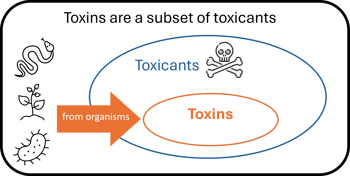
A substance that causes a toxic effect is called a toxicant. Toxicants include chemical substances (both from natural and man-made origins), and natural substances produced by living organisms (‘toxins’).
Toxin, toxicant – what’s the difference?


These terms are sometimes used interchangeably, which is not always correct.
A toxin is a toxic substance that comes from a living organism. Like brown snake venom, atropine from deadly nightshade or botulinum from Clostridium botulinum.
A toxicant is a broader term that includes toxic natural and man-made substances.