-
‘All substances are poisonous: there are none that are not. The dose alone differentiates a poison from remedy’
This concept is attributed to Paracelsus (1493-1541), a Swiss physician, botanist and alchemist, known as the ‘father of toxicology’.
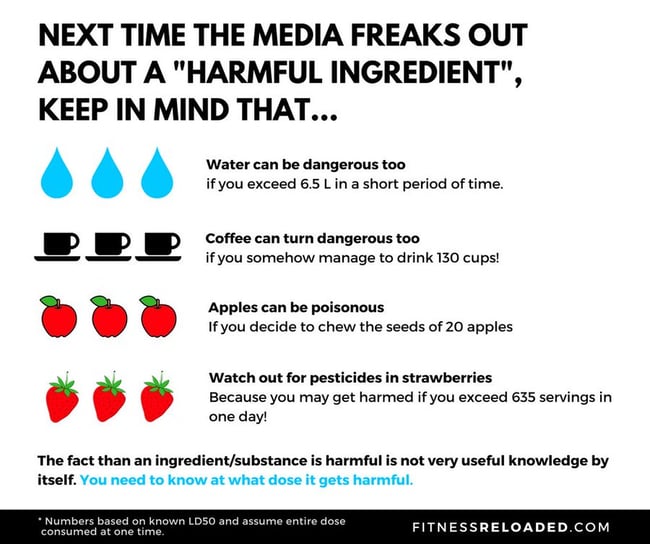
Any substance can be harmful in certain quantities, or in the wrong place, or if used in the wrong way.
Or, to put it in toxicology terms, the risk of harm depends on the hazard – the substance’s inherent ability to cause harm, and the dose – what quantity of the substance, in what concentration, and for what duration of contact.
All chemicals have the potential to cause harm at high enough doses, but there is also a level below which a chemical has no adverse effect. Of course, this applies to natural chemicals as well as man-made chemicals—their origin is irrelevant. And there is no such thing as ‘chemical free’.
Think about some common, natural foods. Apples, pears, potatoes and zucchini all contain substances that are toxic to people. But do we need to worry? No, the amounts are so small that they have no harmful effects.
Or, perhaps more relevant to some, coffee. Every time you drink a cup of coffee, you may be consuming as many as 16 ingredients that are carcinogenic to rodents. If you don’t drink coffee, how about a buttered bread roll with roast turkey and cherry tomatoes? 11 known carcinogens.1 Should we ban coffee, turkey, tomatoes and rolls? Of course not. There is no evidence that consumption of these trace levels is unsafe. Dose is an essential concept here.
Examples of right substance, wrong dose
Vitamin A is essential to the proper functioning of the human body. We get vitamin A from the foods that we eat. However, too much vitamin A can cause poisoning and death. During their famous Antarctic journey, it is thought that Douglas Mawson and Dr Xavier Mertz ingested toxic levels of vitamin A as they resorted to eating the livers of their huskie dogs to survive. Dr Mertz died, but Mawson staggered 160 km to safety. Liver has since been found to be a very rich source of vitamin A.
Or think about aspirin. One or two tablets every few hours can give pain relief. Fifty tablets all at once could cause acute kidney failure, coma and heart failure. - How a substance comes into contact with the body is also important
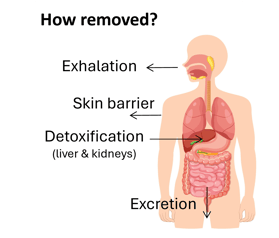
- Just because a substance is found in the body does not mean it causes harm
- Analytical techniques are always improving, meaning we can detect lower and lower levels
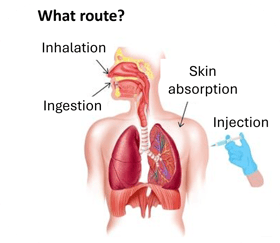 There are four major routes of exposure: