Does 'natural' equal 'good'?
What's the myth?
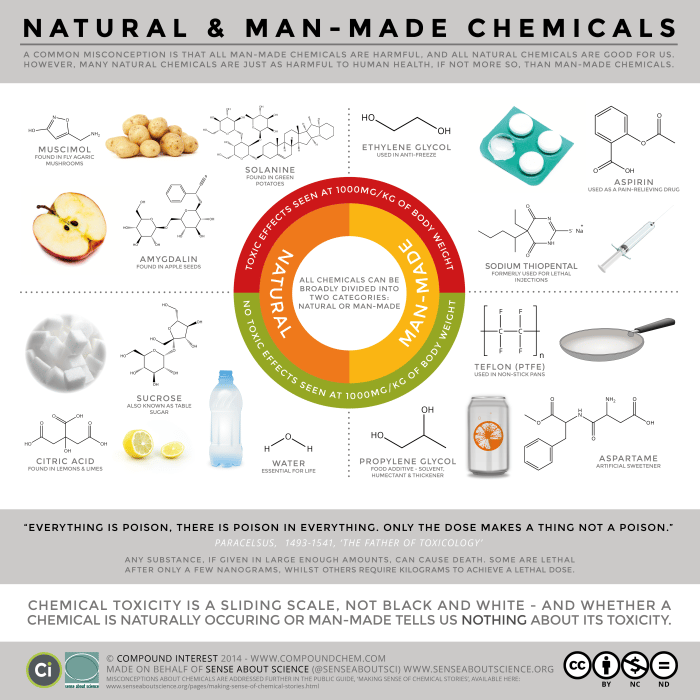
There is a common misconception that natural chemicals—plant extracts, for example—are safer than man-made chemicals.
In fact, this perception that ‘natural equals safe’ is sometimes exploited in marketing.
Read on to learn more about why the origin of a chemical is irrelevant to its safety.
What are the facts?
-
The origin of a substance is irrelevant to its safety
There is no such rule as natural is good, man-made is bad. What is safe and not safe depends on what the substance is, but how much is used and how it is used.
There are toxic, harmful and allergenic substances that are found in nature, as well as from the lab. It makes no difference where the substance originated.
I’m sure you can think of some examples of natural equals very, very dangerous. Think of plants, for example. Notorious for producing toxic substances! As do other living things, like some microorganisms, fungi and animals. Then there are toxic minerals and elements—entirely natural too.
'As I have said many times before, the safety and efficacy of a chemical does not depend on whether it was made by a chemist in a lab, or by Mother Nature in a bush…Its chemical and biological properties depend on its molecular structure’.1
To determine the potential risk posed by any substance, its inherent properties (hazard), and the dose need to be considered together. Not where it originated. Read more about how product risk is determined at Product safety – a common priority?
-
Natural substances can be NASTY
Let’s think about some natural chemicals that could do a lot of harm.
• Clostridium botulinum toxin – a naturally occurring substance and one of the most toxic substances known. It’s been estimated that six grams of pure crystalline botulism toxin (about one teaspoon) would be enough to kill 200 million people.
• Death cap mushrooms – a meal prepared with these poisonous fungi killed three people in Melbourne 2023 and two people in Canberra on New Year's Eve 2011. The mushrooms contain a few different types of toxin, including amatoxins, phallotoxins and virotoxins.
• Tetrodotoxin – the potent neurotoxin produced by the fugu fish. If eaten, it can cause mild numbness and tingling to paralysis, respiratory failure and even death.
• Cicutoxin in water hemlock – ‘the most violently toxic plant in North America’2. Only a small amount is needed to produce poisoning in livestock or in humans.
And there are many, many more.
Even anti-‘chemical’ campaigners agree that natural does not equal safe. The Campaign for Safe Cosmetics and Environmental Working Group state that ‘just because a fragrance ingredient is derived from a plant or an animal source does not mean it is safe for everyone’.3
-
Man-made chemicals can have several advantages over natural chemicals
Chemicals made in a laboratory are also called synthetic chemicals.
Synthetic chemicals can be copies of chemicals that occur in nature, also called ‘nature-identical’. For example, Vitamin C is prepared in the lab from glucose to give the same substance as that found in nature. Any fans of My Cousin Vinny out there? ‘I-dentical’.
Synthetic chemicals can also be different to those occurring in nature, either by modification of natural chemicals or the synthesis of completely new molecules.
Synthetic chemicals can have several advantages over natural extracts:
• Harvesting substances directly from nature can, in some cases, lead to over-harvesting of limited natural resources, like plants, marine organisms and forests. This can disrupt ecosystems, with broad-reaching negative impacts.
• When commercial quantities of a natural substance are required, like a plant extract, the scale of agricultural production may require considerable resources and may be unsustainable or unethical in the longer term.
• Chemical production in a controlled environment can result in higher purity, whereas extracts from natural sources are inherently variable in composition and may contain many impurities.
• Chemical synthesis provides access to a greater range of chemicals, including modified naturally-occurring chemicals (e.g. to decrease their toxicity, or to increase their efficacy) for a multitude of uses.
Man-made chemicals – same-same or sometimes better!
✅ Nature-identical: e.g. Lab-made Vitamin C = Natural Vitamin C
✅ Higher purity: Controlled lab environments ensure consistency
✅ Environmental protection: Avoids over-harvesting wild resources
✅ Greater innovation: We can tweak molecules to reduce harm and increase effectivenessSpot the difference!
Vitamin C from an orange – chemical structure Vitamin C made in a lab – chemical structure 

Other names? Ascorbic acid, or (5R)-5-[(1S)-1,2-dihydroxyethyl]-3,4-dihydroxy-2,5-dihydrofuran-2-one Other names? Ascorbic acid, or (5R)-5-[(1S)-1,2-dihydroxyethyl]-3,4-dihydroxy-2,5-dihydrofuran-2-one
The bottom line?
Any substance—natural or synthetic—can be harmful at a high enough dose. Even water and oxygen, essential for life, can be toxic in excess.
Safety depends on how much you’re exposed to, and how you are exposed, not whether a chemical is natural or man-made.
Sources
- Dr Joe Schwarcz PhD, 20 March 2017, Paraben Phobia is Unjustified
- US Department of Agriculture, Poisonous Plant Research, Water hemlock
- The Campaign for Safe Cosmetics and Environmental Working Group 2010, ‘Not so sexy: The health risks of secret chemicals in fragrance’