Sodium lauryl sulfate – and cancer?
What is it?
Sodium lauryl sulfate (SLS) is a surfactant.
Surfactants, or ‘surface-active agents’ are the active ingredients in all kinds of cleaning and personal care products. Like hard surface cleaners and laundry detergents, body washes, shampoos, creams and toothpaste. SLS is also used as a food additive and in the metal processing industry.
Surfactants do many useful things in these products. They are wetting agents, reducing the surface tension of water so it can penetrate previously non-wettable surfaces. By reducing surface tension, surfactants also act as foaming agents. And of course surfactants act as cleaning agents by loosening, dispersing and emulsifying soils so that they remain suspended in the wash solution.
Although sometimes confused, SLS is not the same as sodium laureth sulfate (which is abbreviated ‘SLES’). SLS is also known as sodium dodecyl sulfate ('SDS'). Yes, chemical names can be a little confusing.
How do surfactants work?
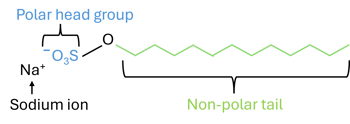
It’s all based on them having two very different components in the same molecule: a long, non-polar, hydrophobic (‘water-hating’) tail and a polar, hydrophilic (‘water-loving’) head group.
SLS’s ‘tail’ has 12 carbon atoms, and its head is the negatively charged sulfate group.
Want some basics on the science behind surfactants (and other ingredients in laundry detergents)? Try the laundry detergent ingredients information sheet.
What's the myth?
You may have heard a myth that has been circulating since the late 1990’s, that SLS in consumer products causes cancer.
This myth may have gained some legitimacy by ‘SLS-free’ claims on some products.
SLS is in so many products. Should you be worried?
Not at all. Read below to learn more about this persistent myth.
What are the facts?
-
There is no evidence that SLS causes cancer
There is no evidence that SLS causes cancer. It’s simply a myth, not worth a second thought.
The International Agency on Cancer Research (IARC) does not classify SLS as a known, probable or possible human carcinogen. Nor does the US National Toxicology Program, California’s Proposition 65 list of carcinogens, the US Environmental Protection Agency, the European Union…
It’s a slam dunk on this one.
-
Products containing SLS are regulated in Australia to minimise skin irritation
The only thing SLS is known to do is irritate the skin. Especially at higher concentrations or when in contact with the skin for longer periods.
To help protect you from skin irritation, some uses of SLS are regulated in Australia via the Poisons Standard.1
For example, manufacturers of rinse-off products containing 5–30% SLS have two choices. The product can display the warning ‘IF IN EYES WASH OUT IMMEDIATELY WITH WATER’. Otherwise, SLS is classified as a schedule 6 poison (a substance with moderate potential for causing harm), which means it must state ‘POISON’ on the container and meet certain packaging requirements.
A few other product categories must also follow the requirements for Schedule 6 poisons: rinse-off products containing more than 30% SLS, leave on products containing more than 1.5% SLS and toothpaste and oral hygiene products containing more than 5% SLS.
At levels below these, no specific warnings or precautions are deemed necessary.
-
Expert assessments found no risk to consumers from SLS as used in cosmetics, personal care and cleaning products
Regulators around the world stand behind the safety of SLS.
Australia’s industrial chemicals regulator, NICNAS (now AICIS), assessed the safety of SLS in 2013. This covered not only the alleged carcinogenicity of SLS, but also other potential adverse health effects.2 Its conclusion? ‘The current controls are considered adequate to minimise the risk to public health posed by the known uses of this chemical in cosmetic or domestic products’.
The 1997 OECD (Organisation for Economic Co-operation and Development) report came to a similar conclusion that ‘the human health hazard assessment for SLS shows that at present the substance is of no concern for the general public’.3
The US Cosmetic Ingredient Review (CIR) Expert Panel found SLS to be safe for use in cosmetic and personal care products in 1983, 2002 and 2010.4
The Canadian Health Department states that ‘there is no evidence to show that SLS causes an undue safety risk to consumers when used as directed in cosmetics’.5
Yep, a slam dunk.
'The perception that SLS is a threat to human health is not scientifically supported, and claims made to the contrary should be regarded as false and misleading'.6
The bottom line?
Rumours that SLS in household products causes cancer are simply untrue. A right royal furphy.
No need to…
look for ‘SLS free’ or spend even a second of worry that this ingredient poses a cancer risk.
But please do...
follow the manufacturer’s instructions when using any product. And please stand up for SLS! Spread the word do debunk this cancer myth as the nonsense that it is.
Sources
- Therapeutic Goods Administration, The Poisons Standard
- NICNAS (now AICIS), 2013, Sodium, ammonium and potassium lauryl sulfate: Human health tier II assessment
- OECD 1995, SIDS Initial Assessment Report on sodium dodecyl sulfate
- Cosmetic Ingredient Review, CIR Portal Ingredient Status Report for SLS
- Canadian Department of Health, Safety of Cosmetic Ingredients
- Bondi CAM et al. 2015, 'Human and Environmental Toxicity of Sodium Lauryl Sulfate (SLS): Evidence for Safe Use in Household Cleaning Products', Environ Health Insights. 2015 Nov 17;9:27–32