Parabens – the pariah of preservatives?
What are they?
You may have seen ‘paraben free’ on skincare and beauty products.
What’s a paraben, and why would a product want to highlight its absence?
Parabens are a group of chemical ingredients. They’ve been used as preservatives in many cosmetics and personal care products, as well as in some foods and pharmaceuticals, for over 100 years.1
Preservatives are important ingredients. They protect cosmetic and personal care products against microbial growth, from contamination by consumer use and extend product shelf life. This protects product quality and, more importantly, your health. (To learn more about preservatives, see Preservatives – protecting products or harming health?)
There are several different parabens. The most common parabens used in cosmetic and personal care products are methylparaben, ethylparaben, propylparaben and butylparaben. Parabens are present in most products at low levels (less than 0.5%).
Parabens are also present (naturally) in many plants. Like carrots, olives, blueberries, strawberries and grapes.
Parabens benefits?
• Low skin irritation, low toxicity
• Broad antimicrobial and antifungal activity
• Well tested
• Safe use for over 100 years
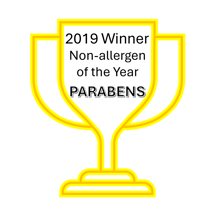
Parabens were named ‘Non-allergen of the Year' in 2019 by the American Contact Dermatitis Society, due to the low frequency of adverse reactions despite the high prevalence of use.2
What's the myth?
Parabens came in at number 6 of the ‘Top 10 Unfounded Health Scares of 2010’.3
Two specific myths persist on parabens in cosmetics and personal care products.
Myth #1: Parabens in underarm deodorants and antiperspirants increase the risk of breast cancer in women
Myth #2: Parabens may affect male fertility
So persistent are these myths that ‘paraben free’ has become a thing – even in the absence of any evidence that parabens are a problem.
This has put pressure on companies to move away from parabens, which means the use of alternative preservatives that may be less effective, not as mild on the skin and likely a lot less thoroughly tested.
Is this warranted?
See below how the parabens used to preserve consumer products are one of the best-tested and safest preservative options around.
Myth #1: Parabens in underarm deodorants and antiperspirants increase women's breast cancer risk
What are the facts?
-
No link between parabens and breast cancer has been found
The 2004 study, in which parabens were found in breast cancer tissue, did not demonstrate a link between parabens and breast cancer, nor did it say it did. This study had several limitations and has been criticised widely.6
Limitations? The small sample size (only 20 breast tumour samples were analysed), no comparison to healthy tissue (to see if healthy tissue also contained parabens), the source of the parabens in the tissue was not identified (it could have been from multiple sources, including foods or medicines), parabens were also found in blank samples without any breast tissue (yes, really!) and no evidence of any link between the presence of parabens and the breast cancer.
It has since been shown that parabens can be present in breast tumour tissue even when underarm deodorant or antiperspirant is not used.7
The European Commission’s Scientific Committee on Consumer Safety (SCCS) concluded in 2005 that 'there is no evidence of a demonstrable risk for the development of breast cancer by the use of underarm cosmetics'.8
Australia’s industrial chemicals regulator, AICIS (then NICNAS) reviewed parabens for safety in 2016 and concluded ‘Based on the weight of evidence from the available well-conducted in vivo carcinogenicity studies, the chemicals in this assessment are not considered to be carcinogenic.’9
Click here for more on underarm deodorants and the breast cancer myth.
Myth #2: Parabens affect male fertility
Some studies have indicated that parabens may affect sperm health and sperm counts. While other studies show no effects.
The fact that parabens have been detected in the blood and urine of male volunteers after paraben-containing personal care product was applied to the skin is seen by some as further evidence for an adverse effect of parabens.
Again, it’s the mild oestrogen-mimicking effect of parabens that has been proposed to link them to male infertility. But is it true?
What are the facts?
-
The effect of parabens on male fertility has been extensively studied
There have been many, many animal studies into potential male reproductive effects of parabens.
In its extensive 2008 report, the US Cosmetic Ingredient Review (CIR) Expert Panel reviewed all the available evidence and data on effects of single- and multi-paraben exposure of adults and infants on male fertility. It concluded that there was ‘no adverse male reproductive toxicity’ and that parabens were ‘safe as cosmetic ingredients in the practices of use and concentrations described in [its] safety assessment’.10
-
Parabens are very weak hormone mimics
In 2015, the Australian industrial chemicals regulator NICNAS (now AICIS) stated that ‘parabens possess oestrogenic activity, although at much lower potency than endogenously produced oestrogens. There are currently no established adverse outcome pathways for weak oestrogenic activity’.9 The oestrogenic effect varies depending on the specific paraben but is over a thousand times less than that of the natural hormone.
There are also many naturally occurring substances that act as hormone mimics. These include substances with oestrogenic effects, or ‘phytoestrogens’, which are found in plant-based foods such as soy, fruits and vegetables. No need to avoid these, either.
-
Regulatory authorities agree that paraben levels in cosmetics and personal care products are safe
Parabens have been extensively studied. Any new data of significance is reviewed by international scientific and regulatory bodies.
Many regulatory authorities allow parabens to be used without restriction in cosmetic and personal care products. Australia, the USA and Canada, for example.
In Australia, parabens were most recently assessed by the cosmetic and personal care product ingredients regulator NICNAS (now AICIS) in 2015, confirming their safety. ‘The available data do not indicate any risks associated with exposure to the chemicals in this group. The chemicals have been shown to have weak oestrogenic activity, but there are no established adverse outcome pathways for this effect.’9
Methylparaben is listed on Australia’s Poisons Standard. 'Uh-oh..?' Not at all! It’s on the list of ‘Substances considered not to require control by scheduling’. That’s to show that methylparaben has been considered and no action was needed. No other parabens are listed on the Poisons Standard.
What is the Poisons Standard
Ingredients that are more hazardous, at certain or any concentrations, are included on the Poisons Standard.
This national classification system controls how chemicals are made available to the public and any mandatory safety warnings on labels.In the USA, methyl and propylparaben are classified as ‘Generally Recognized as Safe’ (GRAS).11 This means qualified experts believe there is enough evidence for the safety of these substances under the conditions of their intended use.
In Europe, parabens are ‘Approved Preservatives’,12 with a maximum of 0.8% total parabens allowed in cosmetics as preservatives and lower limits for individual parabens. South Korea has the same limits as Europe, and Japan has a slightly higher total paraben limit of 1%.
Europe and South East Asia also ban five less-used parabens (isopropylparaben, isobutylparaben, phenylparaben, benzylparaben and pentylparaben) from use in cosmetics. 'Uh-oh?' Again, no. This ban was due to a lack of data necessary for their assessment, not any proven concerns.
Regulatory authorities uphold the safety of parabens in cosmetics
‘The available data do not indicate any risks associated with exposure to the chemicals in this group’
NICNAS (now AICIS), 20159
‘At this time, we do not have information showing that parabens as they are used in cosmetics have an effect on human health’.
US FDA, 202013
‘In addition to propylparaben and butylparaben, other parabens, like methylparaben and ethylparaben, are safe, as repeatedly confirmed by the Scientific Committee on Consumer Safety (SCCS). They are also some of the most efficient preservatives.’
European Commission 201414
The bottom line?
This really is a debunked myth. Parabens are effective and safe ingredients that keep your cosmetic and personal care products free from harmful microorganism growth.
No need to…
look for ‘paraben free’
But please do...
spread the word – parabens have had an unjustified ‘bad rap’ for too long. Alternative preservatives may not be as effective or as mild on the skin.
Sources
- Chemicalsafetyfact.org: Parabens
- Dermnet, March 2024, Contact allergy to parabens
- The American Council on Science and Health 2010. The Top Ten Unfounded Health Scares of 2010
- Darbre PD et al., ‘Concentrations of Parabens in Human Breast Tumours’, Journal of Applied Toxicology, Vol. 24, pages 5-13
- Routledge EJ et al., 1998, ‘Some Alkyl Hydroxy Benzoate Preservatives (Parabens) Are Estrogenic’, Toxicology and Applied Pharmacology, Volume 153 (1), 1998, pages 12-19
- Dr Joe Schwarcz, Office for Science and Society, Separating Sense from Nonsense, 20 Mar 2017, Paraben Phobia is Unjustified
- Barr, L et al., 2012, ‘Measurement of parabens concentrations in human breast tissue at serial locations across the breast from axilla to sternum’, Journal of Applied Toxicology 32, 219-232
- Scientific Committee on Consumer Safety (SCCS) 2010, Opinion on Parabens
- NICNAS, 2015, Parabens: Human health tier II assessment
- CIR Expert Panel 2008, ‘Final amended report on the safety assessment of methylparaben, ethylparaben, propylparaben, isopropylparaben, butylparaben, isobutylparaben, and benzylparaben as used in cosmetic products’, International Journal of Toxicology, 27 (Suppl. 4), pages 1-82
- US FDA SCOGS Database
- CosIng – Cosmetic Ingredients, Annex V, List of Preservatives Allowed in Cosmetic Products
- US FDA, Parabens in Cosmetics
- European Commission, New EU rules on the use of Butylparaben and Propylparaben in cosmetics products