Before trusting what you see on social media or in the news (or before you start throwing out your personal care and household products), ask yourself:
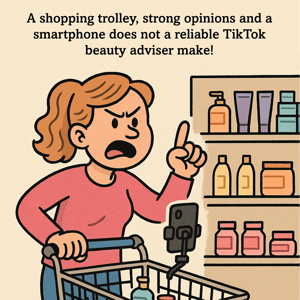 Who’s behind the claim? – Is the author identified? Are they qualified and credible?
What’s their agenda? – Is someone trying to sell something? Push an ideology? Increase their followers? Simply entertain?
Is it backed by evidence? – Are there trustworthy sources? Valid and relevant scientific data? Or just opinion and cherry-picked data?
Is it emotionally charged? – Fear-based messaging often signals bias.
Is it too good (or bad) to be true? – Sensational claims deserve a fact-check!
Is the information up to date? – Outdated warnings can mislead.
Are other reliable sources saying the same? – Cross-check before you act.
Also be cautious of…
• phrases such as ‘associated with’ or ‘linked to’. For example, ‘chemicals associated with hormone disruption’ does not mean that a connection has been established between the chemicals and hormone disruption.
• The phrase 'found in’. Just because a substance is present, whether in a product or in the human body, doesn’t mean that it has an adverse effect. See Extra extra! Toxic chemicals found in…
• Statistics without context. For example, ‘doubles your risk’ sounds scary…unless the risk went from 1 in 10 million to 2 in 10 million in which case it is seriously misleading.
• Studies on animals or isolated cells being used to predict effects in humans. Effects at high lab doses often don’t apply to real-world human exposure. The results need to be considered alongside related scientific evidence.


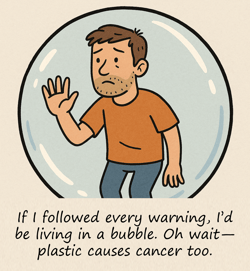 Some of the more bizarre alleged ‘causes’ of cancer
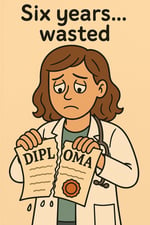 We can also confuse ‘information’ with ‘informed’. And ‘access’ with ‘expertise’.