Skin – an effective barrier?
What is it?
We have a lot of skin. It's one of the largest organs in the human body, making up about 16% by mass.
What does skin do, and why does it play such an important role in protecting our health?
What are the facts?
-
The functions of skin
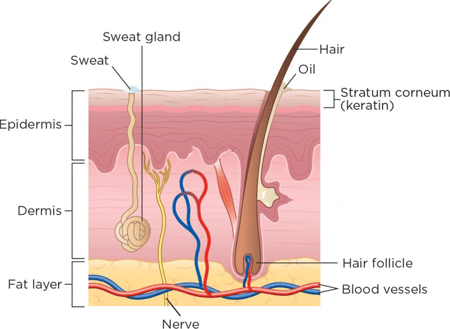
Skin has several layers. An outer layer (epidermis), an inner layer with blood vessels, nerves, hair follicles and glands (dermis), and a deeper fatty layer (also called the hypodermis).
Skin plays a vital role in:
• Providing a barrier to the outside environment. Controlling what is allowed to pass into and out of the body and protecting internal organs against physical injury.
• Temperature regulation. Pores in the skin open and close to regulate the movement of gases and sweat across the skin.
• Insulation. The fatty skin layer helps insulate the body.
• Sense of touch. Skin receptors send messages to our brain in response to stimuli.
• Vitamin D production. The synthesis of vitamin D is triggered when ultraviolet rays from the sun reach the skin.
-
The skin as a barrier
Let’s focus on the skin’s barrier function.
Imagine if everything we put on our skin went through. Or worse, our insides started leaking out. Very dangerous, and pretty gross.
Your skin’s barrier function is crucial for survival. Thankfully, healthy skin is an effective barrier to many particles, chemicals and microorganisms. It’s the top layer, the stratum corneum, that plays the vital role in this barrier function.
The skin barrier works in two directions:
• It keeps water in. Without this, we’d literally dry out. Our cells and organs need that moisture to stay alive and healthy.
• It keeps things out. Think microorganisms, irritants, chemicals and the sun’s UV rays (although of course these can damage the skin). Only some things we touch are able to penetrate our skin. These are limited to very small molecules and those with particular water and oil solubility characteristics.
The challenge of transdermal drug delivery
Think how easy medicine delivery would be if it could be applied via the skin. No pills, suppositories, needles or IVs needed!
A whole area of drug delivery research is focused on overcoming the formidable challenge posed by the skin barrier.
There are two potential ways that a drug could cross the healthy skin barrier: through the stratum corneum (either through the cells or between them), or via sweat glands and hair follicles.
Drug molecules need to be small enough and have adequate solubility in both oil and water AND the drug needs to have suitable pharmacological activity when it gets through.The skin can also fix itself! When the stratum corneum is damaged, the skin accelerates processes to repair the damage and restore the barrier properties.
-
Even babies’ skin is an effective barrier
You have probably noticed that your babies’ skin is super soft and delicate. It may also be more sensitive than your skin and prone to dryness.
Babies’ skin is actually very similar to adult skin but is thinner and has a slightly different structure and composition.2 The skin of full-term babies (born at or after 37 weeks) functions as an effective protective barrier, even as it continues to develop through the first year of life.3
That means your baby’s skin, even though slightly different to yours, is ready to defend your baby against irritants, toxins and infections.
The bottom line?
The skin is a remarkable organ, one that is well designed for the many functions it needs to perform. Including its function as a barrier.
Sources
- Stamatas GN et al. 2010. 'Infant skin microstructure assessed in vivo differs from adult skin in organization and at the cellular level', Pediatric Dermatology, 27(2):125–131
- UK Cosmetics, Toiletries & Fragrances Association, 2012, Children, Their Skin and Cosmetic Products