Cosmetics & Personal Care

Baby products – will they harm your baby?

icon-about@2000x

What are they?

Baby products include personal care products specifically designed for babies (adorable little people that turn night into day and your hair prematurely grey).

These products are designed to clean or moisturise your baby’s skin or to care for their hair and scalp. They are formulated for the special properties of babies’ skin, which is slightly thinner and more sensitive than adult skin. There are also similar products designed for toddlers and other young children.  

Myth icon

What's the myth?

You might occasionally hear that baby products are contaminated with harmful chemicals. Or contain harmful chemicals.

There are few better ways to provoke outrage and alarm than claims of ‘toxic substances’ in baby products!

Or, you might have heard that organic and natural products are best for your baby.

Sigh. Being a new parent is hard enough without having to wrangle with unhelpful claims, unfounded claims, downright misleading claims, and unnecessary fear and guilt. ‘Am I doing the right thing…?’

Let’s have a look at baby product safety, some of the substances that seem to come up from time to time, like formaldehyde, 1,4-dioxane and phthalates. We will also look at the question of whether organic and natural is the way to go.

Facts icon

What are the facts?

  • Trace amounts of a substance does not automatically mean it causes harm

    You may sometimes hear claims like ‘toxic chemicals found in…[insert product name]’. Scary, right?

    Not necessarily. Just because a chemical is present doesn’t mean it is harmful in the amount present.

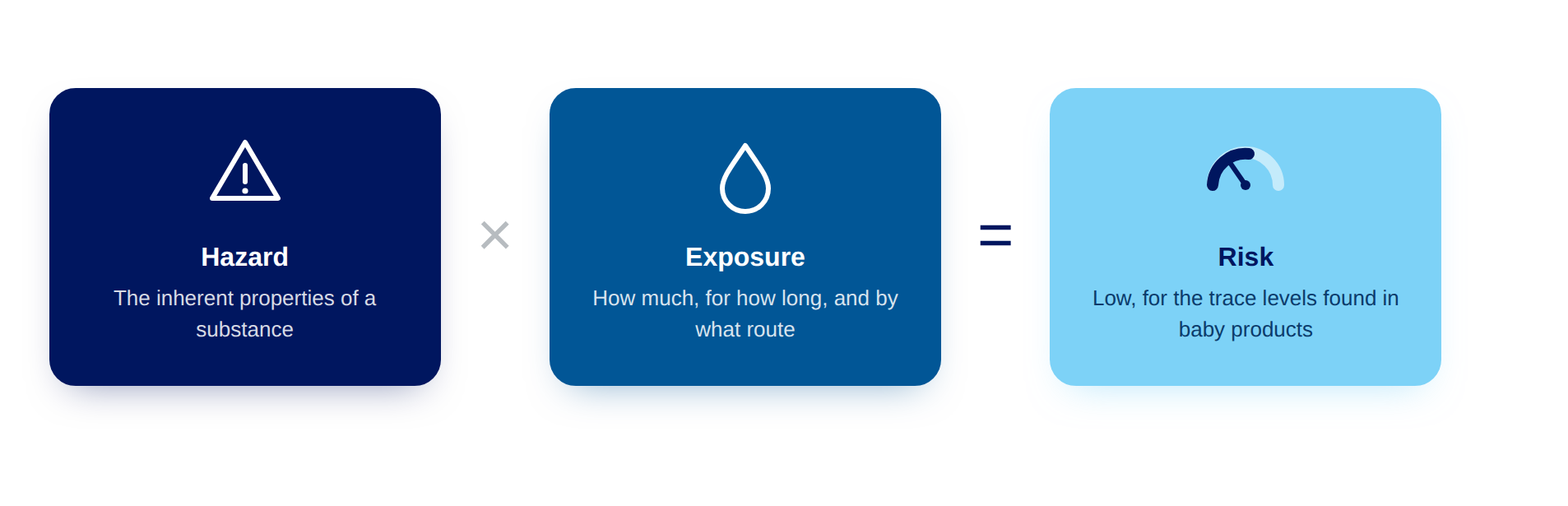
    The risk of harm always depends on two things:

    • Hazard – the properties of the substance

    • Exposure – how much substance, for how long, and via what route
    baby-products_hazard-exposure-risk

    For example, in 2009 a US-based activist group reported that formaldehyde and 1,4-dioxane1 were present at very low levels in some children’s personal care products. But their self-published findings2 did not consider the actual exposure of children to these trace levels or provide any evidence that these could be harmful to children under real-life exposures.

    You would need to wash your baby’s hair 620 times a day, every day, to get close to a harmful level of exposure to 1,4-dioxane from baby shampoo!5

    In another example, a 2008 study found that use of baby products, especially baby powder, lotion and shampoo, correlated with phthalates in babies’ urine.3,4 Again, this study did not investigate any adverse effects from the levels of phthalates present. 

    These are by no means the only substances you may have been instructed to avoid—many websites list substances that they say should be avoided in all baby products.

    The problem is, these all treat hazard as if it was risk. It is worth saying again: Just because a chemical is present doesn’t mean it is harmful in the amount present. For more on this, see ‘Extra! Extra! Toxic chemicals found in...’

Furphies icon

The bottom line?

You can continue to use baby products with confidence in the knowledge that these products are specifically formulated to be safe and kind to your baby’s delicate skin.
No need to…

specifically seek out organic and natural products. While there are many excellent organic and natural baby products, these are not inherently safer for your bundle of joy; all products are regulated for safety in Australia.

But please do...

stop using a product if your baby’s skin reacts to it.

Sources
  1. Both of these ingredients are linked to cancer but are considered safe at very low levels; this is considered in product regulations.
  2. The Campaign for Safe Cosmetics 2009, No More Toxic Tub: Getting contaminants out of children’s bath & personal care products  
  3. Sathyanarayana, S., Karr, C. J., Lozano, P., Brown, E., Calafat, A. M., Liu, F., Swan, S. H. 2008, 'Baby Care Products: Possible Sources of Infant Phthalate Exposure', Pediatrics, vol. 121(2), pp. 259-268
  4. ABC News, February 2, 2008 Potentially Harmful Chemical in Baby Products
  5. Canadian Cosmetic, Toiletry and Fragrance Association, The Safety/Risk Equation [video]
  6. Certified organic ingredients have been certified by an accredited organisation to ensure that they have been grown, harvested and processed without the use of pesticides and synthetic chemicals.
  7. ABC Everyday / Clare Watson, Sun 4 Apr 2021. Avoiding skincare with food ingredients for child eczema
  8. Stamatas GN et al. 2010. 'Infant skin microstructure assessed in vivo differs from adult skin in organization and at the cellular level', Pediatric Dermatology, 27(2):125–131
  9. UK Cosmetics, Toiletries & Fragrances Association, 2012, Baby's skin is a barrier