Cosmetics & Personal Care

Sunscreens - more harm than good?

icon-about@2000x

What are they?

Sun protection is a burning topic (groan) in Australia. As the ‘skin cancer capital’ of the world, most people in Australia need to take care to avoid too much sun exposure.

We all need small amounts of ultraviolet (UV) radiation from the sun to produce vitamin D. But too much UV can result in short- and long-term health effects, including sunburn, skin damage and premature ageing, and skin cancer.

Australia (along with New Zealand) has the highest skin cancer rate in the world.

‘Sunscreen use is one of five important ways of reducing the risk of skin cancer. 

The most comprehensive study of cancer prevention in Australia estimated that, in 2010, more than 1700 cases of melanoma and 14,190 squamous cell carcinomas … were prevented by long-term sunscreen use.’1

Sunscreens are an essential part of sun protection, along with protective clothing, a hat, sunglasses and seeking shade. You have probably heard the motto ‘slip, slip, slap, seek, slide’.

Sunscreens are available in many varieties, including:

  • A range of sun protection factors (SPFs), with a higher SPF indicating greater protection from UVB (short-wavelength UV)
  • Broad spectrum, which acts against the effects of both UVA (long-wavelength UV) and UVB
  • Water resistant
  • Different consistencies such as creams, lotions, milks, gels, sticks and sprays
  • ‘Primary sunscreens’, which means that their main purpose is sun protection, and ‘secondary sunscreens’, which means their main purpose is not sun protection (examples include some moisturisers, lip balms and foundations). 

When you apply sunscreen, it forms a film on the surface of your skin.

Sunscreens can contain many different ingredients with different functions. The ‘active’ ingredients, called 'UV filters', protect your skin from the sun’s UV radiation. Other ingredients may counteract free radicals ('antioxidants'), act as preservatives, provide a suitable texture and consistency, stabilise the formulation, moisturise your skin…

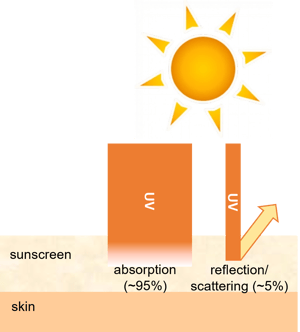
UV filters absorb UV before it penetrates your skin. The two main types of UV filter are organic and inorganic/mineral filters.

icon-science-spot@2000x
 
Science spot: UV filter types
Inorganic/mineral (‘physical’) filters – which in chemistry terms means mineral-based actives, that are not based on carbon. Zinc oxide and titanium dioxide are the main inorganic filters.

Organic (‘chemical’) filters – which in chemistry terms means the actives are carbon-based structures. Examples are oxybenzone and avobenzone. The term ‘chemical’ is confusing, because inorganic filters are made of chemicals, too.

Both types mainly work by absorbing UV light from the sun, although inorganic actives also reflect, or scatter, a small amount of UV. You will find that many sources get this mechanism of action wrong, saying that inorganic sunscreens mainly reflect, or scatter, UV.

One or both types of UV filters may be used in a sunscreen since different UV filters are effective against different UV wavelengths.

Sunscreen how it absorbs UV
Myth icon

What's the myth?

What isn’t the myth!

Sunscreen most myths rosette

There are so many myths about sunscreens. In fact, sunscreens may well win the ‘Most Myths’ award. An unenviable honour.

A 2017 Australian Cancer Council survey showed that Australians are becoming increasingly misinformed about sunscreen.2

Some myths about how sunscreens work, what different terms (like SPF) mean, which sunscreens are best, and about sunscreens preventing us from getting enough vitamin D, we won’t focus on here.3

Then there are many myths that can be grouped under two main themes.

Myth Theme 1: Sunscreens contain harmful ingredients

Myth Theme 2: Sunscreens kill coral reefs

There are also a host of worrying suggestions on what to do instead of using commercial sunscreen. For example:
•    rub your skin with beef tallow instead 
•    get a suntan – it protects your skin 
•    get a fake tan – it protects your skin 
•    make your own sunscreen at home
•    don’t worry about the sun, it doesn’t cause skin cancer… 
•    …in fact, sun is good for you because vitamin D (which our bodies need sunlight to make) prevents cancer

Thank you, TikTok, you minefield of misinformation and erroneous ‘experts’. 

Why are these myths so dangerous?

Because they can cause doubts. Which might deter some people from using sunscreens as part of their sun protection regime, or from using sunscreen properly. Which might leave them at greater risk of sun damage.

Buckle in, it’s going to be a long page…

Myth #1: Sunscreens contain harmful ingredients

There are two main sub-myths here:

Myth 1a – some UV filters, particularly oxybenzone and homosalate, are harmful. You can read more on oxybenzone’s own Furphies page.

Myth 1b – sunscreens contain unsafe nanoparticles.

Facts icon

What are the facts?

Myth #2: Sunscreens kill coral

You may have heard that some sunscreen ingredients can cause coral bleaching.

And that several countries and US states have banned sunscreens containing certain UV filters, most often oxybenzone and octinoxate but increasingly homosalate too, leading to bans and the advent of ‘reef safe’ sunscreens.

Is this true? And are these bans helpful in protecting the natural wonders that are coral reefs?

Facts icon

What are the facts?

Furphies icon

The bottom line?

Sunscreen products are an important and safe part of your sun protection regime (along with shade, clothing, a hat and sunglasses).
Please continue to use sunscreen on exposed skin, according to the manufacturer’s directions, if the UV index is 3 or more.
No need to…

avoid sunscreens, or ‘chemical’ sunscreens, or nanosunscreens, or choose ‘reef-safe’ sunscreens.

But please do...

choose a sunscreen that you are going to use – one that you can afford, is easy to apply and feels nice on your skin. You’ll be much more likely to use the recommended amount! Check the expiry date to make sure the product is still in date and please store your sunscreen somewhere where it won’t get too warm.

Sources
  1. Australian Cancer Council, Now is not the time for Australians to lose confidence in sunscreen
  2. SBS News, 20 October 2017, Many Australians confused about sunscreen
  3. Lab Muffin Beauty Science has some great videos debunking sunscreen myths, including some of these.
  4. Therapeutic Goods Administration: Sunscreens
  5. Therapeutic Goods Administration 2025, Safety review of seven active sunscreen ingredients
  6. McDougall A, 2012, Scientists reiterate nanotechnology in sunscreens is safe, Cosmeticsdesign.com
  7. Therapeutic Goods Administration, 2009, 'A review of the scientific literature on the safety of nanoparticulate titanium dioxide or zinc oxide in sunscreens'.
  8. Wright, PFA, 2016, ‘Potential risks and benefits of nanotechnology: perceptions of risk in sunscreens’, Medical Journal of Australia, Vol. 204 (10), pages 369–370
  9.  Mohammed, YH et al, 2018, ‘Support for the Safe Use of Zinc Oxide Nanoparticle Sunscreens: Lack of Skin Penetration or Cellular Toxicity after Repeated Application in Volunteers', Journal of Investigative Dermatology’
  10. Therapeutic Goods Administration, 11 January 2017, ‘Literature review on the safety of titanium dioxide and zinc oxide nanoparticles in sunscreens
  11. SCCS (Scientific Committee on Consumer Safety), Opinion on ZnO (nano form), 18 September 2012
  12. SCCS (Scientific Committee on Consumer Safety), Revision of the opinion on Titanium Dioxide (nano form), 18 September 2012 Final Opinion
  13. Therapeutic Goods Administration, About sunscreens
  14. Carys Mitchelmore and Doug Fenner, 1 July 2019, Data doesn't back sunscreen bans to protect coral reefs, Florida Today
  15. Katherine Gregory, ABC News 4 May 2018, Hawaii bans sunscreens with chemicals that damage coral reefs, but Australia reluctant to follow
  16. National Academies of Sciences, Engineering, and Medicine. 2022. Review of Fate, Exposure, and Effects of Sunscreens in Aquatic Environments and Implications for Sunscreen Usage and Human Health. Washington, DC: The National Academies Press.
  17. Raimondo, S. 2024, 'Reality check: What can we expect from an ecological risk assessment of UV filters on coral reefs?' Integrated Environmental Assessment and Management, Volume 20, Issue 2, Pages 309–311.
  18. Downs CA et al. 2016, 'Toxicopathological Effects of the Sunscreen UV Filter, Oxybenzone (Benzophenone-3), on Coral Planulae and Cultured Primary Cells and Its Environmental Contamination in Hawaii and the U.S. Virgin Islands', Arch Environ Contam Toxicol. 70(2):265-88.
  19. O'Malley E, O'Brien JW, Verhagen R, & Mueller JF, 2020. 'Annual release of selected UV filters via effluent from wastewater treatment plants in Australia.' Chemosphere, 247, 125887.
  20. Bargar TA, Alvarez DA & Garrison VH, 2015. 'Synthetic ultraviolet light filtering chemical contamination of coastal waters of Virgin Islands National Park, St. John, U.S. Virgin Islands', Marine Pollution Bulletin, 101(1), 193–199.